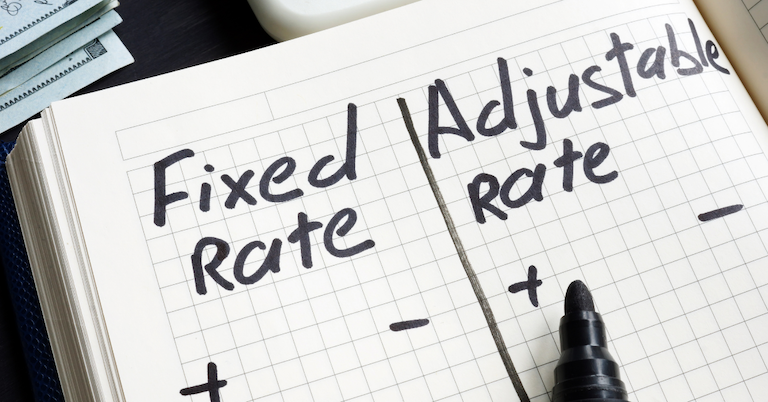
When it comes to mortgage options, buyers have two options: a fixed-rate mortgage or an adjustable-rate mortgage. While both mortgage options ultimately help buyers purchase a home, they do have some key differences.
As a buyer, you want a mortgage loan that makes sense for your homeownership plans and your financial goals. So what is the difference between fixed vs. adjustable-rate mortgages? Here is an easy breakdown of these two mortgage options to help you determine which is best for your situation.
Fixed vs. Adjustable-Rate Mortgage: What’s the difference?
The main difference between fixed-rate mortgage (FRM) and adjustable-rate mortgage (ARM) is the type of interest rate you receive.
With a fixed-rate mortgage, buyers receive a set interest rate and payment that does not change. This means that whatever interest rate you start off will be the same interest rate you will end with for the entire time you have the loan. This means that the mortgage part of your monthly payment remains consistent.
With an adjustable-rate mortgage, interest rates fluctuate over time. Borrowers will usually have an initial interest rate to start out with and keep for a period of time. This is often much lower than the interest rate for a fixed-rate mortgage. However, part of the interest rate you pay will be tied to a broader measure of interest rates. This is called an index. Your interest rate goes up when this interest rate index increases, as does your monthly mortgage payment.
Pros and Cons of Fixed-Rate Mortgages
Pros:
- They are the most common and most dependable mortgage option due to its set interest rate. Long-term homeowners especially enjoy this consistency over time.
- They are easy to budget for as the interest, and therefore monthly mortgage payments, stay the same month-to-month. No worrying about interest rate increases.
- They come with longer loan terms which allows borrowers to spread out payments over time (often up to 30 years).
- They overall help to minimize monthly mortgage payments and make homeownership much more affordable.
Cons:
- They tend to have higher rates than those on adjustable-rate mortgages (at least for the first few months or years of the loan).
- Because of the higher rates, this type of mortgage can be difficult to qualify for. This means you’ll need lower debt–to–income ratio, higher credit score, or more in savings.
- Due to the higher interest and mortgage payments, fixed-rate mortgages may not be the best option financially for short-term homeowners.
Pros and Cons of Adjustable-Rate Mortgages
Pros:
- The interest rates tend to be incredibly low in the beginning, proving great initial savings for buyers.
- Adjustable-rate mortgage rates fluctuate both up and down. This means the rates could potentially be even lower than the initial rate, or decrease if rates do increase during your term. More than likely thought, the rates will stay the same or increase.
- Short-term homeowners benefit greatly from the initial interest rates that come with adjustable-rate mortgages.
Cons:
- Adjustable-rate mortgages are the much riskier option. While most ARM’s come with rate and payment caps, they are still very unpredictable when it comes time for rates to adjust.
- Once the rates begin to fluctuate, it might become harder to budget for monthly payments. The new interest rates could mean that your payment is no longer affordable to you.
- This type of mortgage option is not beneficial for homeowners that plan to stay in the home beyond the rate adjustment period. While there is a chance that rates could stay the same or even decrease, you’ll most likely end up paying higher interest rates and mortgage payments than you would like.
Which Mortgage is Best?
The answer to this question truly depends on your homeownership plans, your financial goals, and what you are most comfortable with paying. Despite the higher interest rates, the majority of home buyers opt for a fixed-rate mortgage. Very few buyers, especially first-time buyers, are not comfortable taking on the risk of an adjustable rate mortgage. Instead, they prefer to have a rate and payment that is steady and predictable.
Of course, that isn’t to say that adjustable-rate mortgages are bad. Adjustable-rate mortgages are much lesser known than their fixed counterpart. Many buyers aren’t even aware that this mortgage type is an option for them. Depending on the situation, it may be the better option.
While an adjustable-rate mortgage may not be the best decision if you are looking to live in the home long-term, it does benefit short-term homeowners. ARMs usually come with three, five, seven, or 10–year fixed–rate periods. As long as you plan to sell or refinance the home before the period is up, you can usually save on both your monthly payment and your total interest costs.
Adjustable-rate mortgages are also a good option if you know that your income is going to increase in the future. Knowing you’ll have significantly more income in the future provides peace of mind knowing that you’ll be able to afford whatever interest rate increase comes your way.
If you plan to have stable financing and intend to refinance your home before the rate fluctuation period begins, ARM’s might also be a good option. Refinancing before those interest rate fluctuates would allow you to opt for another ARM to maintain a low rate. You can also refinance to a fixed-interest rate at that point if you plan to stay in the home longer or want the benefit of consistent payments.
Need a bit of guidance in your home buying journey? Our team at SimpleShowing is here to ensure find the best mortgage options for your goals and financials. Be sure to look into our buyer refund program and let us know how we can help you afford (and save!) on your next home purchase.